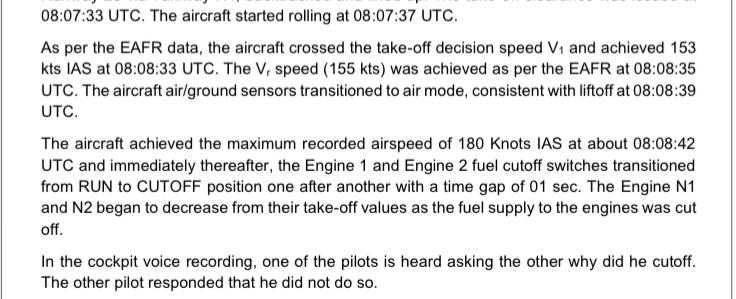
Initial press releases stated that the switches had been moved to off within 0.1 seconds.
One question I haven’t seen addressed. Was there anyone in a jump seat during that final takeoff? Someone besides the captain and fo who could have shut down the engines?
You have it completely backwards. The current situation is what is promoting that “mental health pilots keep flying” because for all but a few very specific cases, it means the end of their jobs. So, what does one do when they’re worried about losing their job over something related to themselves? They hide the condition.
There’s no way around it. If a mental health condition is permanently disqualifying, rather than seeking treatment a career pilot simply does not disclose it on their medical and keeps flying as though nothing is wrong. The fix is to allow these pilots to seek the treatment they need without fear of losing their jobs permanently (except for some extreme cases, just as any other extreme medical case would clearly mean the loss of flying privileges).
"So, what does one do when they’re worried about losing their job "
You nailed it.
Sane pilots with good mental health are problem solvers, both in the air and in their personal life.
Mentally ill pilots (who have trouble even managing their personal life) just might destroy 100 million in property and kill 228 people because they are not.
GaryB beat me to it. Arthur, you live in a world that doesn’t exist. In the real world, mental illness exists and may not be apparent to anyone except the pilot him/herself.
Some people who become pilots will need treatment for depression, anxiety, substance abuse, etc. The only choice is whether we either take away their livelihood and create a powerful incentive for them to hide the problem and not get needed treatment or we create an incentive for reporting by providing treatment and allowing those who are able to continue flying.
Your goal of preventing people with mental illness from flying is a fantasy. Either they fly without disclosure and without treatment or they fly with disclosure and with treatment. Those are the only two options.
Ps: plenty of people with mental illness are “sane.” In fact, you no doubt rely on them daily. They are your trusted doctors, engineers, lawyers, carpenters, nurses, etc.
1 Like
Did the fully autonomous cockpit light just get a little bit brighter???
1 Like
First off, you’re lumping every possible mental health condition as a single “mental illness”, equivalent to lumping a sprained ankle with a major heart attack. It’s a spectrum, not a binary condition. I guarantee that you know at least one person who has a mental health condition but you don’t even realize it because they don’t have trouble managing their personal life.
Secondly, you still completely missed my point that the current situation is what is allowing pilots with mental health conditions to continue flying without treatment or diagnosis. Currently, even going to a specialist to determine if one even has a mental health condition will raise all sorts of red flags with the FAA (and as I understand, most other aviation authorities), so who in their right mind would even go through the process if they feel they can just struggle along on their own and get through it?
It is precisely the near-complete zero-tolerance of mental health conditions in obtaining an aviation medical certificate that leads to all of the possible-or-confirmed cases of a professional pilot “losing” it while in flight.
I guess you’ve never seen how crazy a hallucinating AI agent can get.
" The only choice whether we take away their livelihood and create a powerful incentive for them to hide the problem "
EVERYONE knows going in that physical/mental problems will stop you from flying.
It’s no surprise. If you chose flying as a career then you know that your career is always no more secure than your chances of contracting a debilitating disease or having a serious car accident.
What’s disgusting are people who know the rules but then lie and cheat because they put money above both morals and the safety of others.
“Why did you do that?”. That question on the recorders implies that one of the pilots saw the other pilot shut off the fuel! The question would not have been asked if the issue had not been actually seen. So, it is known who asked and who replied. It is also know what was the tone, urgency with that request. Answer. One of the two deliberately shut off the fuel. Why? We might never know.
Gary, I think the topic of mental health issues in aviation is more a “Chicken & Egg” topic.
Given that psychology did not evolve beyond the range of lobotomies until the early 50’s, mental health issues were widely frowned upon topics. Only then, chemical/ pharmaceutical psychology evolved.
People have always tended to steer clear of people with a “issue”. Back then it was normal to declare anyone hysterical or under siege by dark forces.
Depression, Anxiety Disorders, PTSD, OCD and so many personality disorders were largely unknown territory, with people suffering being locked away.
We count in excess of 200 psychological disorders these days, which are treated by (likely) tens of thousands of medications.
While we slowly figure out, that a lack of psychiatric care/ personal therapy mixed with highly psychoactive drugs may not solve our societal issues, we nevertheless truck on. Prescribe a pill.
Unfortunately, people born in the 40’s to 60’s will be tending to dismiss psychiatric issues as humbug and in their minds, pilots are among the “leaders of society” like doctors, lawyers or other highly specialized professionals. While this is highly delusional, it nevertheless sticks.
These people are fully expected to be immune and above reproach, psychologically fully balanced, starry eyed healthy, fit problem-solvers - unaffected by real life. Heros!
The FAA (or any other regulatory entity) has never been very flexible with its determination of any individual pilots fitness for flight. There are black and white standards which are applied. Take the “wrong” medication and your AME is off the hook and powerless. There is a process to follow that will (1) put you out of work (2) cost time and (3) incredible amounts or money and nerves. Not for no reason, people avoid using their AME as their primary healthcare practicioner. Its often best if these two people never meet… issues are remaining secret, undiagnosed, untreated. That cannot be the purpose of a safety relevant regulation.
Newsflash: Psychological disorders are in a steady climb. Your level of immunity may temporarily vary, but there is no escaping reality…
While on topic, I am reminded of the airline captain who walked out of a fresh Class I ATP Medical Examination and passed away on the way home from a brain aneurism. He was fit to fly until he wasn’t.
If the scenario of a simultaneous dual mechanical failure of the fuel cutoff switches is supported, why didn’t they fail during taxi out or initial takeoff roll instead of the precise time when there would be insufficient response time for an air relight?
Anyone who’s flown with a captain trying to catch his commute flight home knows they can shut both engines down, run a shutdown checklist, grab their bag and blow through the door in a few seconds!
The safety features with start switches generally try to prevent inadvertent starting not shutdown.
I had two thoughts. One was a suicide/mass murder. The other was that this happened right when the gear should have come up. Was this a situation of not having adequate sleep and just going thru the wrong rote motion?
I can see accidentally raising flaps instead of the gear, but even if it was a matter of lack of sleep… why would whoever did it “raise 2 gear levers”?
Hey all you armchair psychiatrists, was the flight crew wearing their jackets at takeoff? Was there a required noise-abatement power reduction after TO? With a weak or disabled detent, it could have been an accident, completely compatible with the CVR. As a design engineer, I would have designed the quadrant with a switch cover linked to Idle Throttle for each engine.
That’s what I said above. I spent some time dealing with human factors in the USAF and thereafter on a major airplane program … those switches either need to be moved OR – as you said – have a SECONDARY protective mechanism so that there’s no possible way to make a mistake; requiring a conscious effort to get at them. They’re too far into the open.
Even though the airplane massively crashed, I’d hope they could find those switches ?? AND … I STILL wanna know if software exists between activation of those switches and some solenoid operated valve closing off the fuel flow. IF so … I’d wager big $$ that was the cause? This AM, they’re saying Boeing stock is up because Air India is saying that the airplane wasn’t at fault. I don’t believe it until Boeing says that the switches are DIRECTLY connected to a valve.
Turning both fuel cutoff switches within 1 sec is quite possible in normal operation. Turning both off simultaneously with one hand is possible with sufficient hand size, but would be difficult.
The AFDR can only record the electrical state of the switch, not the physical position. Since these are electrical switches that send a signal down a wire to an electromechanical device (with or without a software intervention) it is possible for a wire fault (e.g. short) to cause the fuel cutoff valve to close regardless of the switch position. It is not clear where the AFDR gets the fuel cutoff switch state from. It could just be the shutoff valve position.
Having the fuel cutoff switches/levers below the throttles has been a feature of jet transport aircraft design from the very beginning. If this is a design fault leading to inadvertent shutting off of engine fuel supply, it should have cropped up before this accident.
I agree Roger. I have not seen anything regarding what language they were speaking. Is what is being quoted in the English speaking press a direct quote or a translation? If it is a direct quote or a very literal translation, then I think not asking something like “What the hell?” Or “Why did the fuel cutoff?” But instead asking “Why did you switch the fuel off?” seems significant. That’s a specific question indicating he immediately knew exactly what had happened - he knew it wasn’t software or hardware - he knew the switches had been manually switched. I can easily see a scenario where a pilot who intentionally threw the switches might ask that question to obfuscate assigning blame. If that quote is accurate or a very literal translation, then I think that is an indication that the pilot asking the question either directly witnessed the switches being manually switched, looked down and saw them in the off position, or he did it himself.
Boeing has issued an Emergency AD for the 787:
(I HAD to do it!  )
)
Assuming the lockout bump tabs were present, there can be only two reasons for fuel cutoff … crew commanded shutoff OR system activated via automation. Until Boeing tells us that there is no automation involved, I’m going with the latter.