Originally published at: Air India Report Confirms Fuel Cutoff - AVweb
Pilots discussed the movement of fuel cutoff switches as plane entered initial climb.
From previous comments here, its safe to assume that someone who has flown a 787, will be able to explain how two secured fuel cutoff switches could have been turned to off without CA/FO intervention.
My thoughts, as well, Jason. I saw pics of the switches; they’re of the type that have to be pulled up and past definite lockout tabs to be put in the opposite position. I have some of those in my hangar stash and looked at 'em just today. I wonder if this isn’t another suicide situation? Bumping those wouldn’t work to move them. And even if were the cause, how the heck would two of 'em be moved? The airplane couldn’t have taxied all the way to the runway with those switches ‘off,’ so human intervention HAD to occur. There’s more to this story …
Beyond that, I’d question why they were placed so close to the power levers? There ought to be a panel with all emergency control function switches in one place where a glance could confirm positions and allow rapid access to them. Were I designing the airplane’s functions, that’s what I’d do AND I’d have a warning light if ANY switch was in the wrong position for normal ops.
Ultimately, I presume that the smart people at Boeing have been building aircraft for more than 3 days and have a grasp of monitoring systems which determine the aircraft configuration, power lever position, flap settings, wheel rotation/ gear-load, speed, AoA … prior to allowing/ permitting a fuel cutoff on both engines?
I am not aware of the extent to which electronics/ sensors would be capable to override/ prevent the deliberate fuel cut off in certain critical configurations.
IOW, in my mind, attempting to cut fuel in a T/O- / Landing - Config would be answered with a master caution and require another step/ acknowledgement prior to execution. If any system failure/ error was capable to cut the fuel to both engines in such configs, a big can of worms is wide open.
We are not thinking Cessna 172 or light twin where the “accidental” closing of a fuel selector switch is a simply mechanical function, well known cause for fatal accidents and obviously not possible to idiot-proof.
The 787 fuel switches turn the fuel off - period. There is no system to disable them if the airplane doesn’t think you should be doing that. Boeing assumed the pilots would not turn the fuel off at random times just to see what happened next.
Well this was certainly unexpected, considering that all of the aviation world was trying to find a rational explanation. When is the next article due here that promotes mental health pilots keep flying?
Low level engine relights are a muscle memory item. If you’ve ever done them for real or more likely in simulators during recurrent training you know from experience that you don’t want to be fishing around some “all emergency controls panel” for the applicable switches. All jets I have flown have fuel cutoff on the throttle quadrant or even piggybacking on the throttle levers themselves for a reason.
Arthur, your reference to mental health assumes it to be the only factor motivating human behavior associated with placing fuel switches from run to cutoff immediately after liftoff. Whereas mental health may more likely motivate such behavior in western industrialized societies, one needs to accord just as much or even more weight to political and cultural motivations in other societies as well. That said, with the increasing breakdown in disciplined political rhetoric in western industrialized society, we might soon also be needing to factor that into our human behavior motivations.
Can both fuel switches be operated within 0.1 seconds of each other (maybe with one hand?) - and - regardless of aircraft config?
Sounds highly interesting from a litigatory standpoint, even if a extended suicide scenario was in progress.
Considering that throwing a Master Caution or requiring an extra step during a time when a fuel cutoff is particularly unreasonable, would be fairly simple?
Well … I came across this Indian (not wild!) report this AM. They’re intimating that operating those switches doesn’t DIRECTLY shut off the fuel … e.g., operate a fuel flow solenoid. Software control is in between those switches and and actual fuel flow shutoff function. And, it appears that this HAS happened once before without dire consequences on a landing sequence. That the RAT was deployed signals that both fuel flows were turned off within a very short period of time … not likely. And the CVR seems to confirm this.
SO, I amend my opinion … looks like Boeing (or someone’s?) software may be the culprit. IF that’s true … we have another 737MAX problem here, boys ?? Automation … it’s a wonderful thing … until it isn’t.
MSN?
Irrational behavior is a mental health behavior; it’s important.
You are correct that there is also the “cultural” component when the pilot asks “why did you throw those switches” and the immediate responses was “no I didn’t”.
Once again, Arthur - even if there was a mental health component to this accident, chances are that it may take years to be found out - if ever.
I am not willing to hazard a guess about the real number of pilots with untreated and undiagnosed depression, however I am willing to bet the true (unofficial) number of pilots, crewmembers, controllers, mechanics and safety critical aviation staff with depression may cause some severe sweating…
And the fun fact, nobody would know about it. According to doctrine, flying with untreated/ undiagnosed depression provides a paycheck… 
No matter what ultimately caused the issue, 250+ people are dead and many thousands are affected.
If the fuel shutoff was possible during a highly critical phase of the flight, it will be legitimate to ask why, given the electronics and the incredible mass of data being monitored during operation of the aircraft.
Simple plausibility check. Is it plausible/ justifiable to cut fuel to both engines during departure or landing of the aircraft, considering the time it takes to restart and get these engines back into performance mode?
If the answer is no, then why was it possible?
I have never flown a plane in my life where this was not possible and I bet you haven’t either.
My max number of bodybags was limited to 12 + collateral. Piston and some Turboprops.
Here’s a video of someone operating those switches:
Data matters, Larry. If both switches moved within 1 second, I’d fly with human interaction. Initially the breathless media reported (referring to compiled data in the initial assessment) that the switches moved within 0.1 seconds.

Yeah … I noticed the main body removed as well, Jason. Curious? Are we getting too close to reality here or … ??? It sure looks like the two options in this tragedy are that one of the crew moved the switches OR there’s a problem with the airplane’s automation? IF it’s the later, Boeing has another BIG problem. Given that we now know that both crew were very high time competant aviators, I’m going with the later. Hopefully, the data analysis is capable of providing the info needed for a determination? As an engineer, I STILL question why those switches are so close to the power levers and why there isn’t secondary protection to prevent inadvertent activation. Even just a clear plastic door or similar. That said, I cannot be convinced that one of the two pilots could inadvertently activate BOTH switches in that short period by accident.
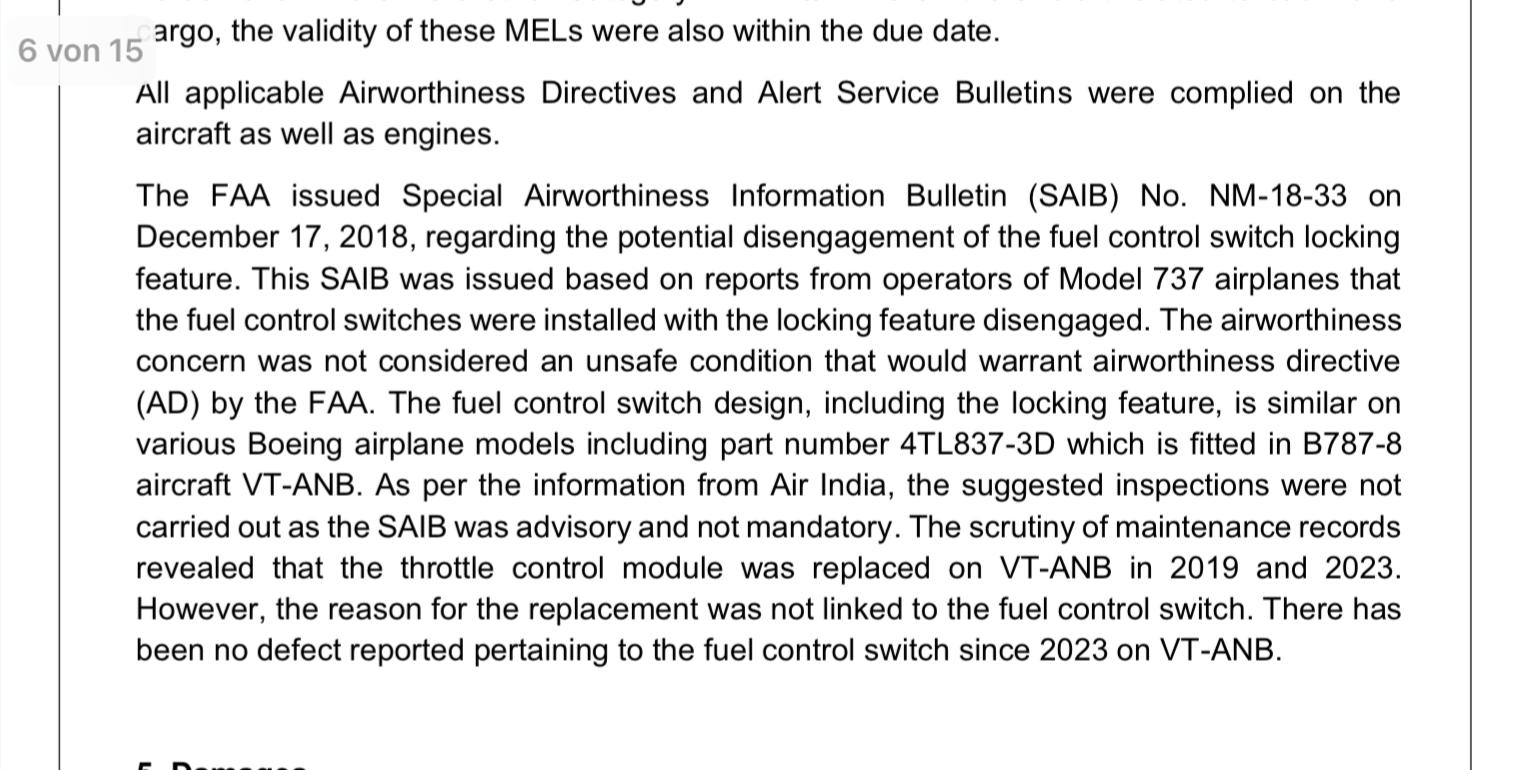
Above SAIB gives a bit of background on those switches. Someone, somewhere mentioned a previous incident during a less critical phase of flight with a 787, however I was unable to duplicate this via source.
The preliminary accident report has potentially triggered news outlets to read the two fuel switches being turned to off within 0 1 (0.1 or 1) seconds. As everything else in the report is timestamped - down to the second, not more precisely, except for the exact time the fuel was shut off.
At this point, the suicide narrative looks a bit flimsy.
I’m pretty sure flight data recorders record control and switch states (inputs), not just software states (outputs) so it would be pretty clear if this were an automation error which doesn’t sound likely.
I bet both switches could pulled and be moved simultaneously with one hand, but regardless I don’t think moving both switches within 1 second of each other is anything exceptional.
Skylor