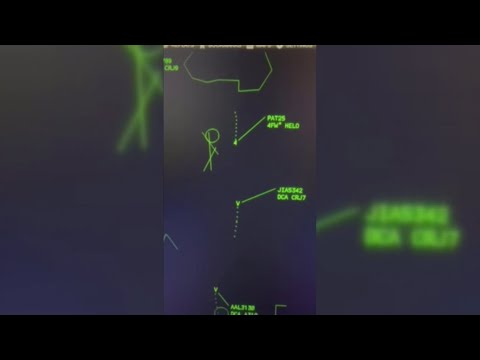
The radar replay has been out for a long time. The “they were at 300 feet!” stuff comes from their mode C info - if the transponder had been off there wouldn’t have been any altitude reporting.
The ADS-B data wouldn’t have added much. It has 25 foot resolution rather than 100 foot resolution, but the ATC radar displays only show 100 foot increments anyway.
Thank you for your service, Captain Denari. Similar experience here, in the civilian sector though. 32+ year ATC (retired) and current ATC instructor at one of the world’s busiest towers. Great explanation and excellent narrative. I agree 100% with your assessment.
At the risk of being pedantic, if either pilot had seen the aircraft they hit, they wouldn’t have hit it. Unfortunately, there was a readily available wrong aircraft to see on the runway 1 final, and that’s the most likely explanation. There is always a risk of that with visual separation - this isn’t the first time such confusion has occurred. It usually works out better, though.
markdenari
(Mark E. Denari, CAPT U.S. Navy (ret))
24
Scott, I concur with your assessment. The mishap investigation will highlight two (2) primary causal factors in this tragic, pilot error mishap – one (1), acute spatial disorientation (seeing the wrong acft. and not seeing the one they impacted), and two (2), poor situational awareness.
Given what happened, I can only speculate that the IP didn’t see the CRJ and felt they had adequate “visual separation” from the acft. or object he did see.
I would bet dollars to donuts on this. Especially since it seems that the information about the aircraft circling was stepped on. When the controller asked if the helicopter had the original sight when the conflict alert went off, the helicopter reported it did. They saw an aircraft where they thought they’d see one.
I have 15 years of experience at a tower and I have probably have had over a couple dozen times where I noticed the pilot might have the wrong aircraft in sight (getting too close, cutting off the guy they are supposed to follow, etc). When I see this occur I restate where the aircraft is and ask if they have that one in sight.
For this situation the controller asked if the helicopter had the CRJ in sight. The pilot saw aircraft #2 on a straight in and assumed it was the CRJ. The whole situation could have been avoided had the controller simply said “off your left” when he asked. He did nothing wrong by not saying such and all indications from the helo told him the situation was managed. Tragic comedy of errors.
I was a center controller, never tower, but when I saw that radar replay with the CA going off I would have directed a left turn even if they said it was in sight - that wasn’t looking good at all Having said that (and it was just my personal reaction) the tower controller heard the magic words twice and would have expected that the conflict was resolved - twice. Hard to fault him, really - he identified the potential issue when they were miles apart, took action, and thought it was fixed. Why wouldn’t he?
And despite all the “accident waiting to happen” hyperventilating, they’ve been running those routes for 25 years. The fact that ATC needs to identify and resolve conflicts is why we have ATC in the first place. Wait until they find out that en route aircraft sometimes converge at crossing points and need to turn or change altitude…
Understood, but “turn 30 degrees left” fixes the conflict whether they see the right aircraft or not.
One of my OJT “rules to control by” was “You’re not done when you tell a pilot what to do - you’re done when they do it.” The whole idea of control instructions is to produce an observable change in aircraft behavior - in this case, the controller expected the initial “maintain visual” instruction to result in a ground track that separated the two aircraft. That didn’t happen, so he tried again - still hoping for a change in ground track, no? But by leaving the separation entirely to the pilot, you don’t know exactly what they’re going to do, even if you know exactly what they need to do. By the time the CA is going off, what I’d want to ensure is a very specific and observable left turn. Might as well make that the instruction instead of pure visual or “pass behind.” But that’s radar thinking…
Maybe this is the difference between center environment and tower then because helicopters having visuals and passing 1/8th of a mile or less behind is super common and the targets still merge on the scope. Either we appreciate the convo
There were MLAT tracks for the helicopter, which is where the flight path information everyone has been using came from. Also is responsible for the odd discontinuities in the flight path data. MLAT triangulates Mode S, ergo Mode S was on. Here’s corroboration from a USA Today article, though:
“However, the helicopter was not broadcasting ADS-B and was broadcasting only Mode S, a secondary surveillance and communication system.
ADSBexchange was able to triangulate the flight path of the helicopter using multilateration (MLAT). was able to triangulate the flight path of the helicopter using multilateration (MLAT).”
Ummm….that may be how ADS-B Exchange was tracking it, but FAA was using transponder data from the DCA and ADW ASRs. FAA does use multilateration in very limited scenarios, but not this one.
It’s also somewhat common to get “bad hits” in areas near airports. Radar interrogations and replies can bounce off large metal expanses like hangars and produce false targets. That may have happened here.
This is a great discussion. As a Canadian private pilot only i am not very famiar with all the technical acronyms and abbreviations. However, i think the route cause and key to frequent repetition of this collision is much simpler and can be summed up as “you can’t go that way”. There is plenty of other geography and safer approaches to the base. Its crazy to rely on routes and procedures that have no margin of error. As for it being classified, when a helicopter passes 2-300 hundred feet overhead it’s not a secret to anyone ! Don’t rely on the infallability people or systems. Take another route.
c180tom
(Tom Jensen (please don't post, I get confused with a detective on the Green River Killerf)
36
Thanks, Raf.
I think all are overlooking the “WHY?” behind this disaster.
Fears of Cold War nuclear attack on Washington, D.C., led to the creation of “escape plans” for government officials, including Congress, to relocate to secure facilities like Mount Weather. This was part of the U.S. government’s “Continuity of Government” (COG) program, which aimed to ensure the survival and functionality of the government in the event of a catastrophic attack.
Those plans are just fine, but the necessary practice of flying helicopters near DCA should have included suspending simultaneous commercial traffic to avoid this accident waiting to happen. Because that would inconvenience congress and others who demand more flights into DCA. (That the same congress who (under)fund the FAA)
Tom: that achilles heel (Congress) has been there f-o-r-E-V-E-R. I’ve watched for it, holding my breath… but turned blue. To date, you’re the first to lay the corpses at the correct door.
After the midair, Congress moved with H.R.1898 – the Military Helicopter Training Safety Act of 2025.
The bill calls for studying whether collision avoidance systems and ADS-B IN should be installed across military helicopters.
It’s a start — but not nearly enough.
The collision wasn’t just about a Black Hawk with ADS-B OUT turned off.
It was the result of a system that had been broken for years.
Route 4 at DCA forced helicopters under Runway 33’s final without proper vertical or lateral separation — and with no real wake turbulence protection.
Controllers and pilots kept it working, but they were holding together a flawed setup, made worse by military and civilian traffic split across separate frequencies, with situational awareness hanging by a thread.
Situational awareness isn’t a buzzword — it’s the 3D mental picture every pilot and controller relies on: who’s out there, where they are, and what’s moving where.
The night of the crash, that picture collapsed — and when it did, there was no backup.
ADS-B matters, but it’s only one piece.
The real fixes have to go deeper:
Redesign dangerous corridors like Route 4.
Put everyone on the same frequency near runways.
Keep ADS-B OUT active unless it’s absolutely mission-critical to turn it off.
Equip ATC with better tools for low-level and “dark” ops.
Build real procedures — not just rely on local skill and luck.
Train civilian and military teams together before the next disaster forces it.
Fully staff ATC positions to manage traffic safely.
H.R.1898 touches the technology, but not the structure.
Until the airspace and the way we manage it are rebuilt, we’re still flying on borrowed time.
It wasn’t just one helicopter that went unseen that night.
It was a system that had been deficient for years — and unless the deeper problems get fixed, it’s only a matter of time before it happens again.
I’m well aware ATC doesn’t use MLAT, I was replying to the previous post requesting a source stating the 60’s Mode S was on, which it had to be if MLAT was possible. And most of the visuals in the news reports and YouTube videos used the MLAT data because that’s what was openly available at the time.